Category 5 Hurricane Matthew may Impact US, but Uncertainty Remains

Hurricane Matthew, now a category 5 storm with winds in excess of 160 mph, is well on its way through the Caribbean, but is expected to take a sharp northerly turn sometime over the next 24 hours.

Current Rainbow Top Infrared Satellite view of Hurricane Matthew provided by the NOAA.

Hurricane Matthew is now, (unofficially as of 7:oo am 10/1/16), a category 5 hurricane, with winds in excess of 155 mph. Overnight, some interesting shifts in the computer models, a the NAVGEM as well as the GFS now point to a potentially devastating storm in the Northeast US sometime over the next week, on the other hand, the ECMWF has held firm in its ‘out to sea’ stance. There will be some interesting things to look for come the 12z run (by about 2:00 pm Eastern Time), so we’ll keep you updated.

*Hurricane Matthew is an extremely dangerous storm, it is highly recommended to prepare and evacuate as ordered by your local governments should they do so. Please consult The National Hurricane Center at http://www.nhc.noaa.gov for more info.*

Major Hurricane Matthew Taking Aim at Carribean

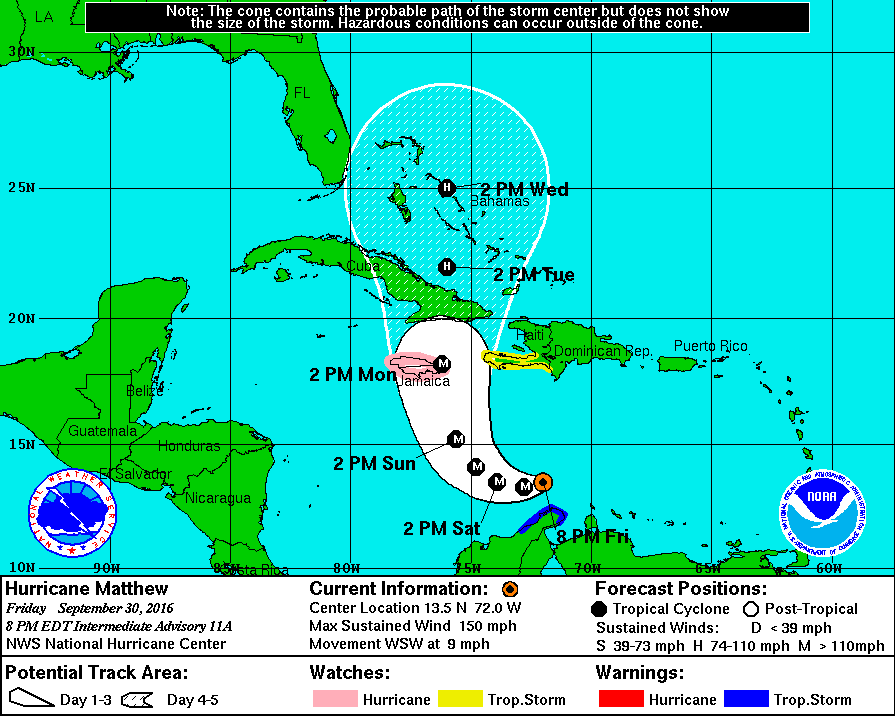
Hurricane Matthew, now a major hurricane, has undergone rapid intensification over the past 24 hours. The National Hurricane Center has posted Hurricane Watches for Jamaica, as the storm is expected to make landfall there as a category three storm in a few days. After making landfall in Jamaica and traversing Cuba, Matthew is expected to reemerge over The Bahamas as a strong category 2 or weak category 3 storm.

Pictured above is the HWRF computer model simulated Infrared Satellite image for Wednesday October 5. This image was provided by Tropicaltidbits.com.

As far as forecasting the track and intensity of Matthew after this point, not much can be said besides that the storm will either skim the Southeast’s coast before turning out to sea, or the storm will ride parallel near to the coast all the way up to Canada. Either way, Hurricane Matthew poses a serious threat to life and property in locations ranging from the Caribbean to the Eastern Seaboard. More updates will be available here, and on our Facebook page over the following several days, but for official information, please consult The National Hurricane Center at http://www.nhc.noaa.gov.

Hurricane Matthew.gif
Above is The National Hurricane Center’s projected path for Hurricane Matthew over the next 5 days. Hurricane watches are currently posted for all of Jamaica.


Hermine Tracks East, Remains a Threat to Tri-State

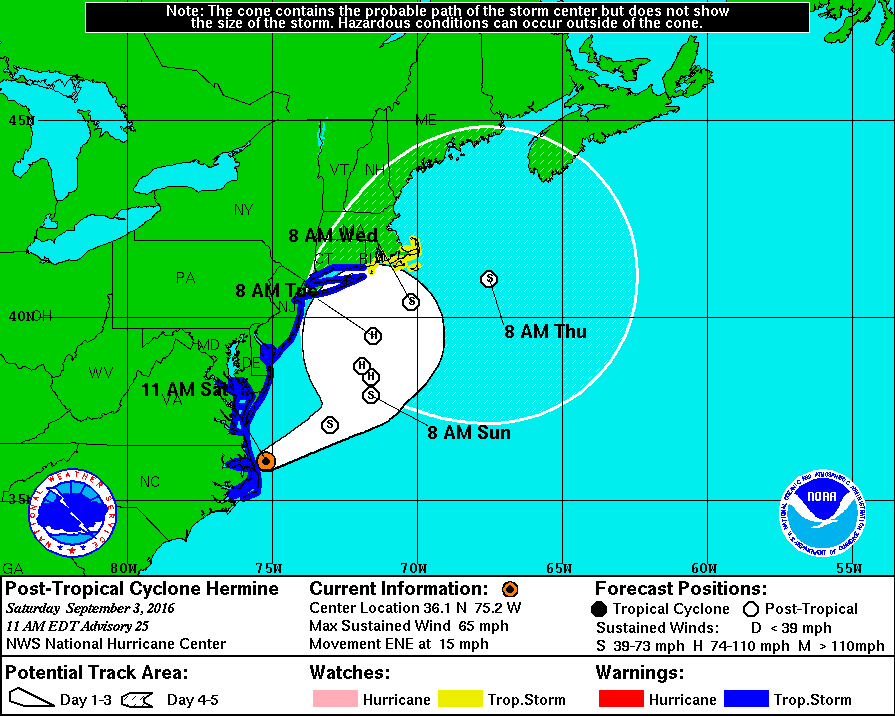
Hermine continued its east-northeastward track overnight, bringing it to the eastern side of the NHC’s ‘cone of uncertainty’.  Although the effects from Hermine along the coast will be less significant for large swaths of The Mid Atlantic and southwestern New England, Hermine still poses a threat to life and property.

Labor Day Weekend is normally a time when people go to the beaches to celebrate the unofficial end of summer, but rip currents, high waves, and high winds from Atlantic City to Boston may put a damper on your plans. Along with this, expect there to be wind gusts high enough to bring down some large branches and trees, especially on Monday, bringing up the potential for some spotty power outages.

For more information on Hermine, visit our Tropical Cyclones page and check for official information at hurricanes.gov and weather.gov.

Tropical Storm Warnings For Tri-State Area

The National Weather Service in Upton, New York has issued Tropical Storm Warnings for locations across The Tri-State Area. Storm Surge Watches and Warnings are also in effect.nhc hermine post tropical ts warnings.gif

Sustained winds in excess of 40-60 MPH are possible with this storm from New Jersey to Connecticut, creating the potential for widespread power outages, blocked roads, and high waves. The National Hurricane Center is expecting a storm surge of anywhere between 1 and 8 feet depending on the location, especially on the south facing shores of Long Island. Now is the time to act! Make sure you have a 3 day supply of food and water as well as flashlights, a weather radio, and portable batteries if at all possible. If evacuations are ordered for your area, do not hesitate to leave. The potential track for this storm remains somewhat uncertain, so please stay informed over the following several days. Official information may be found at hurricanes.gov (NHC), and at weather.gov (NWS).

Invest 99L Poses Threat to US Mainland

Invest 99L is an area of disturbed weather and thunderstorms currently moving west-northwestward at about 20 mph just east of the Leeward Islands. The storm has already defied some expectations that further organization would stall until the area of low pressure moved closer to Hispaniola, and has prompted an Air Force Reserve Hurricane Hunter aircraft trip into the storm later this morning. In the short term, a bit of a model consensus has been reached in terms of whether will the storm go north or south of Hispaniola, and over the past several days, more and more computer models have moved their tracks further to the north of the cyclone-killing mountains in Haiti and The Dominican Republic. The most likely storm track is as follows;  the storm will likely go north of Hispaniola and into the Bahamas before either being pulled north, or continuing on a track west over Florida (Sorry for the uncertainty, it’s still a bit early…) The most likely tracks do have one thing in common beyond the short term track though; most suggest landfall of at least a Tropical Depression somewhere on the East Coast of The United States. Whether the storm traverses Florida and makes another landfall somewhere in the Gulf before being pulled back into The Atlantic, or whether the storm moves up The East Coast, The United States will likely be impacted in some way, shape, or form by what is now Invest 99L.  It is important for those on The East Coast of The United States as well as those on the west coast of Florida to monitor the situation as it progresses and to stay tuned to updates from the National Hurricane Center.

Here's a look at The Tropical Atlantic Basin Satellite Imagery. 
Tropical Depression Fiona is north of The Leeward Islands, 
Invest 99L is east of the Leeward Islands,
And Tropical Storm Gastone is just west of The Cape Verde Islands.

More detail regarding Computer Model variations and outcomes can be found at our Hurricane Center page, where Weather360 is currently covering Invest 99L, Tropical Storm Gastone, as well as Tropical Depression Fiona in The Atlantic.

Rounds of Storms Firing Up in NYC Metro Area

Thought it was over? Well, guess again…

Over the past hour and a half, a line of thunderstorms brought periods of heavy rain, gusty winds, and lightning to mostly northern portions of the Tri-State Area.  Although this line of storms may have cooled things down a bit, there is yet another, larger line of thunderstorms that has the potential to bring even more severe weather to the Metro Area later on in the evening.  With respect to the first line of storms, although they may not have gotten their act quite together when it comes to supercell development, they still packed a punch able to take down large branches, leaves, and lower visibility to less than a mile in some locations temporarily.

The line of storms that is expected to move into the Metro Area tonight will have even more ingredients necessary for Severe Weather Development in their favor.  After the first line of storms earlier, the Mixed Layered CAPE, instead of dropping off, skyrocketed from 700-1,100 joules per kilogram, to 1,500-2,000 joules per kilogram.  Along with this, there has been a notable increase in Effective Helicity as well as Effective Shear, indicating that stronger and more developed storms are on the way.

The most important thing to remember today is that the storms are not over, and that it will be important to have access to NOAA Weather Alerts via an NOAA Weather Alerts Radio or via Cellular Phone so you can stay informed if Severe Weather hits.

Potential for Severe Weather in NYC Today

Starting this afternoon, the potential for Severe Weather exists across the New York City Metropolitan Area.  The first storms will begin to appear over the western portions of the Metro Area in the early afternoon, before becoming more numerous and greater in size by the early evening.  At the moment, it is beginning to appear that there will be at least one line of storms that will form over The Hudson Valley around 3:00-5:00 PM EST.

It will be important to note that Weather360 is increasing the threat for Severe Weather today to 60% across the Metro Area, with the threat for isolated spin-ups and tornadoes at 22%.  The primary threat today will be the threat for small hail, high winds, frequent lightning, and heavy rain.  It is advisable to keep a weather radio nearby and to keep a lookout for storms in your area.

For more information, visit our YouTube Channel here, and in the event of an emergency, be sure to heed all advice distributed and issued by The National Weather Service.

Severe Weather Outbreak and Tornado Warnings

ALERT: The National Weather Service in Albany, New York has issued a TORNADO WARNING in effect until 4:30 PM Eastern Standard Time.  The National Weather Service is also maintaining a TORNADO WATCH for the entire NYC Metro Area until 10:00 PM EST July 1, 2016.  Heed all warnings set out by the National Weather Service and take all necessary common sense precautions.

This evening into tonight, several rounds of potentially severe thunderstorms are expected to move through the NYC Metro Area, bringing with them damaging winds, hail, lightning, and torrential rains.  The first round of storms has already produced several severe thunderstorms and one storm capable of producing a tornado. Please be advised that in order to receive up-to-date weather alerts and warnings, one will have to consult the National Weather Service via Weather Radio or online.  Weather360 estimates there is a 66% chance for Severe Weather Development to continue throughout the NYC Metro Area going into tonight.

These storms are expected to continue for up to several hours, creating the possibility for widespread power outages and downed trees and tree limbs.

For more information, please consult the National Weather Service while we here at Weather360 will continue to inform you of upcoming threats via our YouTube Channel or right here at Weather360.net.


Severe Weather to Impact NYC

The National Weather Service has issued multiple Severe Thunderstorm Warnings for the New York City Metro Area.  This comes after a day of pouring rain that has saturated the ground.  These storms will impact the area over the following several hours and may bring wind gusts of upwards of 60 mph along with lightning and some hail.  Weather 360 advises to heed all warnings and to go inside if not already to avoid potential injury.

NYC Weather: Snow in April?

This is the Third Edition of the NYC Area Week Outlook by Weather360

Monday:  A wintry mix in the morning will transition to all rain by the afternoon.  Total snow accumulations of up to a couple of inches are possible in some (mainly northern and eastern)  portions of the area.  Highs will hover around in the low to mid 40’s.

Tuesday: Highs dropping into the low to mid 30’s will be associated with clearing skies, making it seem much more like January than April.

Wednesday: High temperatures will peak in the mid 40’s as skies become increasingly cloudy, due to an incoming low pressure system.

Thursday:  Rain associated with a low pressure system moving in from the west will bring in much more seasonable temperatures, with a high in the upper 50’s.   This rain could spell the end to winter for many Ski Resorts throughout the Northeast.

Friday: Cooler temperatures along with clearing skies will make for a somewhat more seasonable day.

The Weekend:  Highs in the 40’s along with mainly clear skies will make for a brisk, cool, early spring weekend.

In the event of an emergency weather situation, please consult the NWS at weather.gov and/or your local Emergency Management Office.