Tropical Storm Erika may impact Southeast Coast, but will it make it there?

As of 11:30 AM EDT/AST

Tropical Storm Erika has sustained winds of about 50 MPH with gusts upwards of 60 MPH.  The storm is moving west-northwestward at the moment over the Dominican Republic.  Tropical Storm Warnings are still in effect for Puerto Rico, the Virgin Islands, parts of The Turks and Caicos along with The Bahamas, and all of Hispaniola.  Hurricane Hunter Aircraft are in the storm.

The Track

This image is made public by the South Florida Water Management District (.gov)

The track seems to be locking in and narrowing down, well, at least compared to yesterday at this time, but nonetheless, the expected track and intensity are still at a state of ‘low confidence’ as mentioned by the NHC in their latest Tropical Forecast Discussion.  The general trend though, is that the storm will pass over Hispaniola over the next day, then turn northward toward Florida, then possibly re curving, to go back over the Atlantic and to head up the East Coast.  For those in Florida or along the Southeast Coast of the United States, please continue to monitor the situation, as the cone of uncertainty continues to include the possibility of a major storm impacting the Eastern Seaboard.

Intensity, Will She Survive?

Who knows, Erika is seeming to have a mind of her own as she has not followed the official NHC track whatsoever over the last several days.  Although this is true, over the past hour or two Erika has seemed to finally get her act together (or the NHC for that matter) in determining the track, because Erika’s center of circulation along with her discombobulated thunderstorms have seemingly begun to shift to the northwest.  Erika is expected to strengthen at least to a higher-grade Tropical Storm by the NHC, and by a very consistent computer model, the GFDL, a major Category Four storm off of the Southeast Coast.  But what is the driving force behind its intensity?  Mountains…

Believe it or not, the only difference in the computer models is if Erika will be torn up enough by the mountains for it not to reform to a well-defined system.  According to the NHC, Erika will be so torn up by Hispaniola’s mountains, that it will not be able to strengthen too significantly before potential impact with Florida.  This whereas the GFDL computer model along with some others, suggest a less torn-up version of Erika and strengthen her rapidly, causing her to not impact Florida for too long and move her up the US East Coast quickly as a large Major Hurricane (as of 6 UTC.)

Official Alerts:

Tropical Storm Warnings are in effect for The Virgin Islands, Puerto Rico, all of Hispaniola, The Turks and Caicos, The Bahamas.

Tropical Storm Watches are in effect for parts of Cuba, and the northwest portions of The Bahamas.

Weather 360 3.A.S.: Tropical Storm Warning areas are under a Level I Emergency,  Locations under Tropical Storm Watches are under a Level II Alert, and a Level III, Be Aware, statement is for the Entire East Coast from Florida to Massachussetts.

Weather 360 will continue to keep you updated on the progress of Erika.

Computer models pointing to the rapid development of Invest 91-E in the Eastern Pacific

AS OF 9:30 PM EDT 7/28/2015

The National Hurricane Center in their most recent update on the Eastern Pacific indicates the growing support among the computer models of a rapidly growing storm in the Eastern Pacific.  At the moment, the National Hurricane Center has odds of development for this storm over the next five days at 90%, an increase of 20% in two days, along with the odds of development over the next 48 hours up to 30%, up 30% from two and a half days ago.

Why would this tropical disturbance develop if the last one to develop failed so miserably?

First of all, this time around, the shorter range computer models did not really at one point indicate that former Invest 90-E (now weakening Tropical Depression Eight-E) would develop into a massive storm, but this still does not give reason to why Invest 91-E would develop.  The reason for the increased odds of development for Invest 91-E (as opposed to Invest 90-E) is due to the warmer waters.  Invest 91-E is further to the south than Invest 90-E was at the same longitude.  This along with the fact that the ridges of high pressure steering this storm bring it into an area where wind shear (upper level winds that tear off the tops of Tropical Cyclones), is relatively at the point where there is close to zero of this phenomena.

All the ingredients are at the moment seeming to come together for what could potentially be a much larger tropical event than of its most recent predecessor, former Invest 90-E.

So for more updates regarding this storm system, stay tuned to Weather 360, and for emergency information, contact your Local Emergency Management Office if you are in the path of any current, or future storm.

Hawaii Hurricane Soon?

WEATHER 360 IS RECOMMENDING AWARENESS FOR THE FOLLOWING POTENTIAL STORMS IN HAWAII.

At the moment, several different computer models are still forecasting what could potentially (emphasizing potentially here), be a significant hurricane or other tropical entity landfall.

WHAT?!?!?!?!?

Before anyone goes crazy with the explanation points, Weather 360 would like to continue to emphasize this is only one of many potential scenarios involving two areas of interest in the Eastern Pacific moving over into the Central Pacific area.

Still, what!?

According to the European computer model (Euro or ECMWF), the top computer model in the world in terms of forecasting, at least one of these disturbances moving west-northwest from the Eastern Pacific Basin may develop into a full fledged hurricane, one of which may have its potential eye set on the islands of Hawaii.  With the latest computer model run from the ECMWF, we can once again get a knew perspective on this potential storm(s).  In this new computer model run, one will be viewing a hurricane forecasters (potential) nightmare. With a pressure below 960 millibars, indicating a potential category 3 storm pre-landfall, this storm could have winds exceeding 120 MPH.  If this storm was to make landfall in the state of Hawaii, it would be one for the history books, this storm would go along the not terribly long list of major hurricanes to impact the islands of Hawaii.  Although only one major computer model is depicting this (again), potential storm, the reason Weather 360 is focusing in on this event is because the ECMWF is normally known for playing down major tropical events and changing their forecasts rapidly, and this storm has been suggested by the ECMWF for nearly a week.

I know this is the ‘best’ computer model for accuracy, what do the other computer models say?

Well, just recently (meaning over the past day or two), the GFS (known as about the 2nd ‘best’ computer model) along with many others, have been continuing to key into several variations of this scenario.  One of which includes the first and the second storm system impacting the state as Tropical Storms.  So, for those who may happen to be in Hawaii, or those expected to be there shortly, stay tuned for more updates, and for emergency information on this event, contact your local emergency maganagement office or the NHC (The Honolulu Center for Hawaii).

Post-post…:  Weather 360 will now cover any tropical event that may impact the U.S., whether it be Maine, or Hawaii.

Potential hurricane may impact the state of Hawaii

Over the past several computer model runs, the European Computer Model has consistently shown a disturbance forming in the Eastern Pacific that would make its way to the west-northwest over a period of several days that may render Hawaii as a potential target for this sub-995 potential millibar storm.  Although we are emphasizing the fact that this is only a POTENTIAL scenario, it is best to be alert and aware for anyone either in or going to the Central Pacific state of Hawaii.

ECMWF 7 23 15 FORECAST AS OF 12Z POTENTIAL HAWAII HURRICANE 992 MILLIBARS This image is a filter of the ECMWF from Tropicaltidbits (.com), depicting a potential hurricane in the Central Pacific in approximately 10 days time.

For more information you may rely on us here at Weather 360, but please, for emergency information, please rely on the National Hurricane Center and Weather.gov, along with your local emergency management office in the event of a potential landfall.

We’ll keep you updated on this event as time progresses.

NHC ups the odds for tropical development in the Gulf

The NHC has increased the odds of tropical development in the Gulf of Mexico.  This morning, the odds for tropical entity development in the Gulf of Mexico according to the NHC has been raised to about 20% over the next five days.  This area of tropical disturbance is expected to cross the Yucatan Peninsula and drift into the central, western Gulf of Mexico, where it will have the opportunity to develop and strengthen (slightly), before moving over land somewhere on the United States Gulf of Mexico shore.

There are several different outcomes that may occur for this tropical disturbance.   Outcome one: The GFS computer model along with the ECMWF (The European computer model) are expecting this storm to stay as a weak tropical wave and only bring some moisture and wind to the Gulf Coast.                                                                                   Outcome two: This outcome, mainly promoted by the CMC computer model with some others, suggests that the disturbance will develop into a Tropical Depression or Tropical Storm before making landfall somewhere on the Gulf Coast (likely somewhere in between New Orleans and Brownsville (TX).

At the moment, tropical development is still not extremely likely, but we will keep an eye on this storm over the next several days.

Another disturbance forming in the Atlantic?

The National Hurricane Center (NHC) has created a watch area for a clump of thunderstorms beginning to develop a very weak low pressure.  The computer models have been suggesting that this clump of thunderstorms may develop and grow into some sort of tropical entity and bring some rain and wind to unknown portions of the western Gulf of Mexico Coast.

At the moment, we have not made an official prediction because the NHC is keeping this disturbance’s odds of development at 10%, although once this disturbance’s odds of development do come up, you can look for our official location and intensity forecast on our Hurricanes page.

NHC 5DAY CHART 6 12 15

This is the graphic set out to the public by the National Hurricane Center pertaining to today’s weather conditions across the Tropical Atlantic Basin.

We’ll keep you posted as more information on this disturbance arrives.

TROPICAL STORM ANA MAKES LANDFALL IN SOUTH/NORTH CAROLINA

The 50 MPH Tropical Storm Ana has just made landfall in South/North Carolina, bringing with it, rain, thunderstorms, and some storm surge.  Tropical Storm Ana is the first storm of the Atlantic Hurricane Season, and is also one of the earliest landfalls by a Tropical Cyclone on record. With Hurricane Season starting in over 20 days, some are now wondering how severe this upcoming season will be now… (this information can be found here at Weather 360.)

Where is Ana heading now?

083430W5_NL_sm(NHC prediction cone from earlier this morning.)

Where is Ana heading now?  Well, according to this NHC prediction cone, Ana is making landfall right now in South/North Carolina, (the border of), and will soon lose its Tropical Storm characteristics, but will remain as a Tropical Depression (Ana) with winds of about 30 MPH up until impacting southern New England and Long Island with some waves and some wind (and some rain.)

Weather 360 will keep you posted, stay safe!

WATCH OUT! Tropical Storm Ana to form soon!

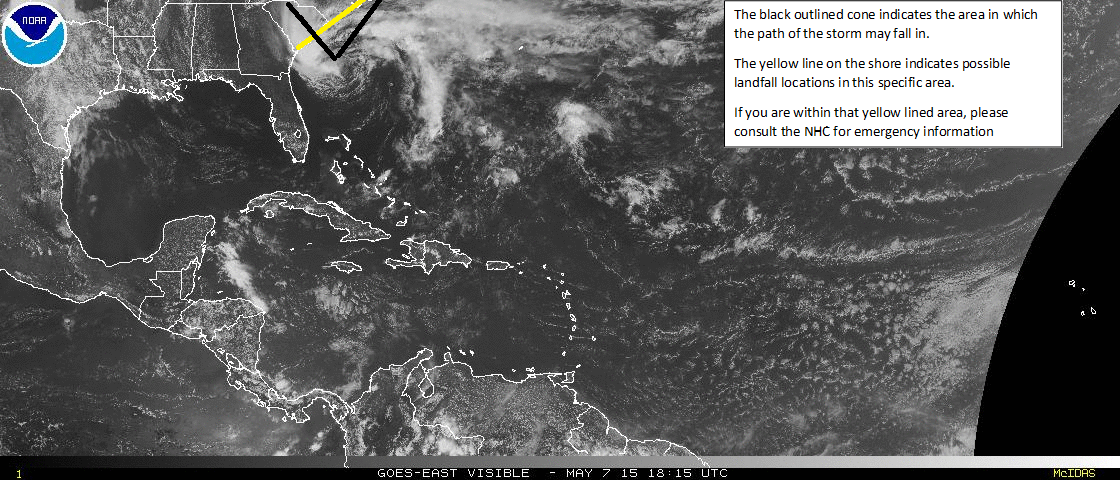
Over the next few hours, the very well defined and string tropical disturbance near the coast of the Carolinas may develop into a strong tropical storm.  With sustained winds already hitting 50 MPH and a very closed and well defined center of circulation, the NHC will have to begin issuing watches and warnings for the coastal areas of the Southeast (and even potentially the rest of the East Coast.)  This storm’s intensity will likely stay as a medium to strong Tropical Storm, and will likely track up through the edges of the Carolinas into the Atlantic Ocean near Long Island, before likely veering off to the east with the high pressures.

Have our look at the following graphic from Weather 360, the yellow means potential landfall locations from this storm.  We apologize for the clarity of the following image.

Untitled

IF YOU live on or near the coast of the Carolinas, please take IMMEDIATE ACTION according to the NHC and YOUR LOCAL EMERGENCY MANAGEMENT CENTER.  Please take all appropriate actions suggested by both your local center and the NHC to keep you and your property safe from the storm.

Be smart, and stay safe!

THE NHC ISSUES FIRST WATCH AREA OF THE YEAR FOR WHAT COULD BECOME TROPICAL CYCLONE ANA

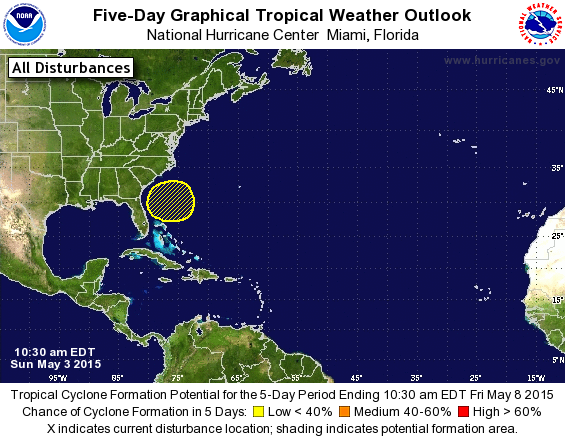
FIRST NHC GRAPHIC OF THE YEAR OF WHAT COULD BE ANA! The first NHC Tropical Watch area of the SEASON!

ITS OFFICIAL! This is now one of the earliest starts to the Atlantic Hurricane Season!  A tropical disturbance that we have been talking about for the past several days has now been highlighted by the National Hurricane Center in Miami, Florida.  As of now, Weather 360 will update our Hurricanes 360 page several times daily through November 30th of 2015.  This potential storm has the potential to strengthen into a hurricane and at the moment for a 5 day forecast by the NHC has a 30% chance of developing (which will likely significantly increase as next week approaches.)

Weather 360’s hurricane package will be free for a little while (at least the beginning of hurricane season) to show you the advance options we include in it.  The hurricane package (which we will rename for now) can be accessed by simply hovering your cursor over the Hurricanes 360 page and clicking on the dropped page below.

If you have not noticed about this storm, that although it has 30% odds of development, it is not classified as a medium chance, right?  Well, yes, since last hurricane season the NHC has changed their standards, meaning that now anything below 40% odds of development at the time of forecast initiation will be in the “low”, and therefore yellow shade.

Here’s a look on the NHC’s special statement on this disturbance

Tropical Weather Outlook Text

ZCZC MIATWOAT ALL
TTAA00 KNHC DDHHMM

SPECIAL TROPICAL WEATHER OUTLOOK
NWS NATIONAL HURRICANE CENTER MIAMI FL
1030 AM EDT SUN MAY 3 2015

For the North Atlantic...Caribbean Sea and the Gulf of Mexico:

1. A non-tropical area of low pressure is expected to form north of
the Bahamas later this week. This system could gradually acquire
some subtropical characteristics by Thursday or Friday as it moves
slowly northward. The next Special Tropical Weather Outlook will be
issued on this system by 11 AM EDT Monday.
* Formation chance through 48 hours...low...near 0 percent
* Formation chance through 5 days...low...30 percent

Forecaster Brennan

Stay safe, and lookout for a YouTube video to come out soon on this disturbance along with constant updates on Weather 360!